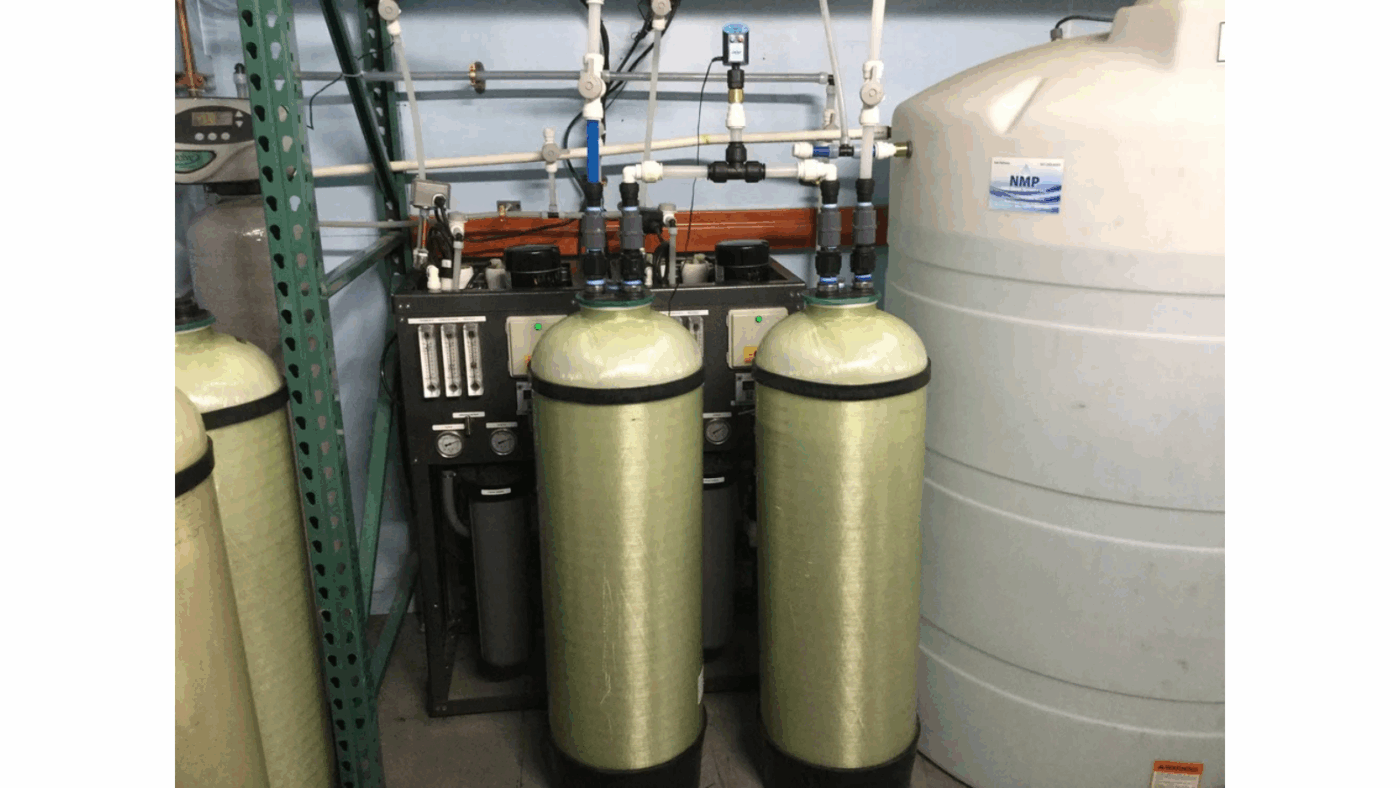
NMP utilizes superior quality American made DI resin which can be selected to properly accommodate your facility’s needs. Our service team will come to your facility deliver, install, and exchange the DI tanks on a periodic basis.
Back to Products
FAQs on DI Water & Deionization Systems
-
What industries need deionized water?
DI water is commonly used in manufacturing, laboratories, electronics, metal finishing, pharmaceutical operations, automotive applications, and other industries where dissolved minerals could interfere with products, equipment, rinsing, or production processes.
How is deionization different from reverse osmosis?
Reverse osmosis uses pressure and a semipermeable membrane to reduce a broad range of dissolved contaminants. Deionization uses ion-exchange resin to remove electrically charged dissolved ions. RO and DI can also be combined, with RO providing pretreatment and DI providing additional polishing.
Does a DI system require maintenance?
Yes. DI resin eventually becomes exhausted as it captures dissolved ions. We provide periodic DI tank exchange and system service to help facilities maintain high water purity.
Can deionized water be used for drinking?
DI water is primarily produced for commercial, laboratory, manufacturing, and industrial applications rather than everyday drinking. Drinking water systems are designed around different treatment goals and requirements.
What is the difference between reverse osmosis (RO) and deionization (DI)?
RO physically separates many dissolved contaminants from water using a membrane, while DI uses ion-exchange resin to remove charged minerals and salts. When very high-purity water is needed, DI can be installed after RO as a final polishing stage.
How do I know when my DI tanks need to be exchanged?
DI tanks should be exchanged when the treated water no longer meets the required purity level. Conductivity or resistivity monitoring can indicate when ion levels are increasing, and the resin is becoming exhausted. NMP Water Systems can establish an exchange schedule based on your facility’s water use and treatment requirements.
Is DI water safe for plumbing in my facility?
DI water can be more aggressive toward certain plumbing and system materials because it has very low levels of dissolved minerals and ions. It may leach metals or other constituents from unsuitable piping, fittings, storage tanks, and distribution components. The appropriate materials depend on the required water purity, application, temperature, flow conditions, and system design.